Watch Words, Part 2: Who Really Owns Your Swiss Watch?
Three groups, a charity, two families and a buyout: the owners behind the name on the dial, and why one third of the Holy Trinity answers to a holding company.
The name on the dial tells you who designed the watch, and it often says nothing about who owns the company. Most famous Swiss brands belong to one of three groups, a few answer to families, and the biggest name of all belongs to a charitable foundation. This is Part 2 of Watch Words, our multiple-part guide to watch vocabulary, and today covers ownership: the Swatch Group, Richemont, LVMH, family houses, sister brands, minority stakes, the Holy Trinity, private equity and the management buyout.
SWATCH GROUP
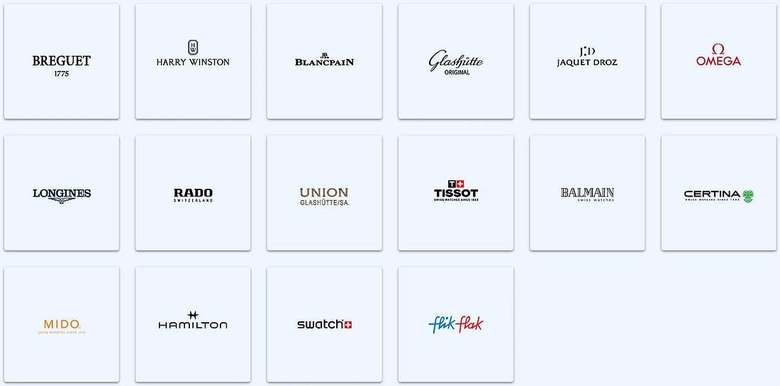
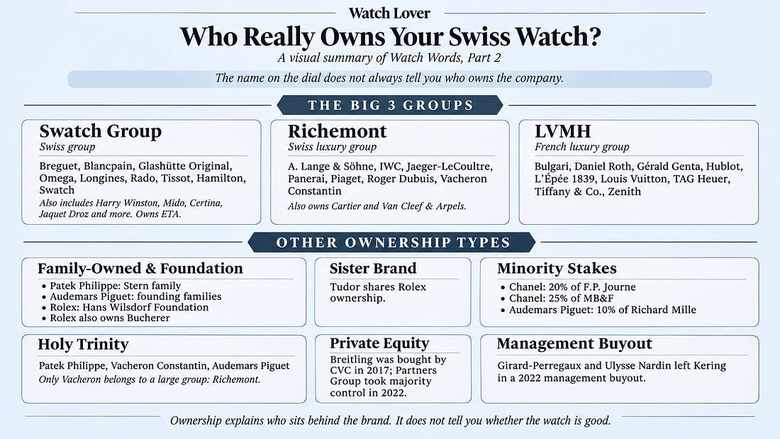
The Swatch Group is the Swiss company built around the plastic Swatch, and its own brand list runs from Breguet, Blancpain, Glashütte Original, Jaquet Droz and Omega at the top to Longines, Rado, Tissot, Certina, Mido, Hamilton and Swatch below them. It bought Harry Winston, the American jeweler, in 2013. The group also owns ETA, a movement maker, which ties back to the ébauche from Part 1: the same group can sell you the finished watch and supply the base movement inside another brand’s.
RICHEMONT
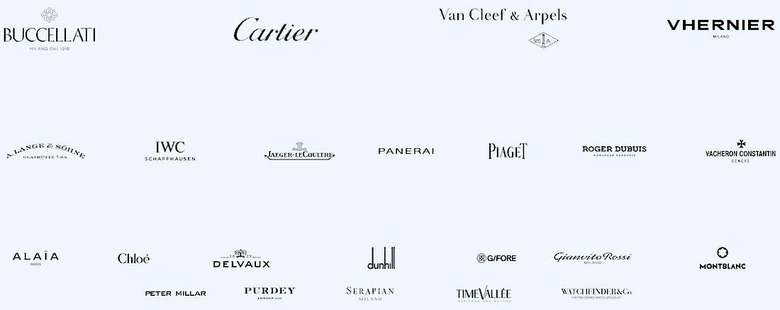
Richemont is the Swiss luxury group from Part 1’s maison entry, and it holds its annual meeting in Geneva. Its watch division, which it names Specialist Watchmakers, holds A. Lange & Söhne, IWC Schaffhausen, Jaeger-LeCoultre, Panerai, Piaget, Roger Dubuis and Vacheron Constantin. Cartier and Van Cleef & Arpels, which also make watches, sit in its jewelry division. Groups sell brands as well as buy them: Richemont sold Baume & Mercier to Italy’s Damiani Group in a deal completed July 1, 2026. A buyer comparing a Lange and a Vacheron at a boutique is weighing two brands with the same owner.
Read Watch Words, Part 1: Is Rolex an Independent?
LVMH
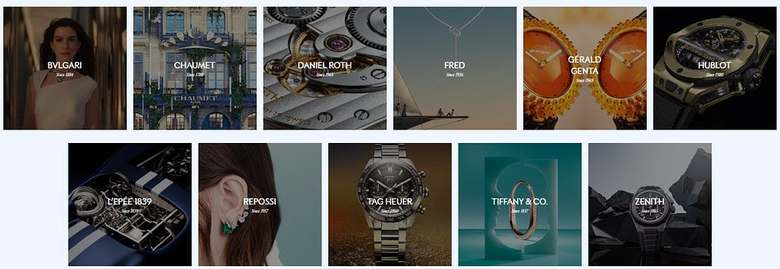
LVMH is the French luxury group behind Louis Vuitton and Dior. At its Watch Week in Milan in January 2026, it showed nine watch brands: Bulgari, Daniel Roth, Gérald Genta, Hublot, L’Epée 1839, Louis Vuitton, TAG Heuer, Tiffany & Co. and Zenith. Inside a group, brands also supply each other. WorldTempus, a Swiss watch news site, reported that TAG Heuer and Bulgari make certain components for other LVMH brands, and that L’Epée 1839, a Swiss clockmaker, builds mechanical objects for Louis Vuitton and Tiffany.
FAMILY-OWNED AND THE FOUNDATION
A few of the biggest names belong to no group at all.

The Stern family bought Patek Philippe in 1932, during the Great Depression, after years of supplying its dials, and still owns it.

Audemars Piguet remains with descendants of its two founding families.

Rolex belongs to the Hans Wilsdorf Foundation, a private charitable foundation its founder set up in Geneva in 1945, which took ownership when Wilsdorf died in 1960. Rolex trades on no stock exchange, so no investor can buy into it. It owns a retailer too. In a deal announced Aug 24, 2023, Rolex bought Bucherer, the Lucerne-based chain that sold its watches since 1924, and Bucherer still runs under its own name.
SISTER BRAND

A sister brand is a second label under the same owner, usually sold at a lower price. Tudor is the best-known one. Hans Wilsdorf, the founder of Rolex, had the Tudor name registered in 1926 and set up the company Montres Tudor SA in 1946, and the Hans Wilsdorf Foundation owns both brands today. Tudor makes its own designs at its own prices, and pre-owned listings on 1stDibs, the online marketplace, still introduce it as Rolex’s little brother.
MINORITY STAKE

A minority stake is part ownership without control, and it is how big houses back small makers without buying them outright. Chanel, the French fashion house, bought 20% of F.P. Journe in 2018 and holds 25% of MB&F, two of the independents named in Part 1.

Audemars Piguet owns 10% of Richard Mille, according to SJX, the watch magazine. Independent, in practice, can still mean a partner in the room.
HOLY TRINITY
The Holy Trinity is the collectors’ name, from the 1970s, for Patek Philippe, Vacheron Constantin and Audemars Piguet, three Swiss houses founded in 1839, 1755 and 1875. No association grants the title and no rule keeps it fixed. Two of the three are family-owned, and Vacheron Constantin, the oldest of the trio, is a Richemont Maison. Rolex sits outside the Trinity, and Bob’s Watches, a pre-owned dealer, gives the question of Rolex its own section in its Trinity guide.
PRIVATE EQUITY

Private equity firms buy companies with money from investors, run them for some years and plan a sale or a stock listing. Breitling is the clearest case in watches. CVC Capital Partners, a London-based firm, bought it from the Schneider family in 2017 and hired Georges Kern, a former Richemont executive, as chief executive. Partners Group, a Swiss investment firm based in Zug, took majority control in 2022 and called Breitling an independent Swiss watchmaker in its announcement, and Kern said he was happy that the brand “remains privately owned and independent.” By Part 1’s ownership test, he is right, since no watch group owns Breitling. Our view: a brand whose owners plan an exit is independent in a different way from a brand run by the family whose name is on the dial.
Read Girard-Perregaux: Making the Invisible Visible
MANAGEMENT BUYOUT
A management buyout happens when the people running a company buy it from its owner, and it is one way a brand leaves a group. Kering, the French group behind Gucci, bought Sowind, the parent of Girard-Perregaux, in 2011 and added Ulysse Nardin in 2014. On Jan 24, 2022, Kering agreed to sell all of Sowind to its management, led by Patrick Pruniaux, chief executive of both brands. Both brands went back to private hands in one deal, and Kering left the watch business.
Ownership explains prices, shared parts and why two rival boutiques can answer to the same boardroom. It never tells you whether a watch is good.
Next in Watch Words: how Swiss is a Swiss Made watch?
ABOUT
Watch Lover XO is written by two collectors who wear and follow watches, from everyday favorites to rare independent pieces. We cover the secondary market, new releases and the watchmakers behind them.
For more images and videos, follow watchlover.xo on Instagram.