The Four Winners of the $10.5B H1 2026 Secondary Watch Market
Rolex leads on scale, Richard Mille on price, Tudor on turnover and F.P. Journe on growth.
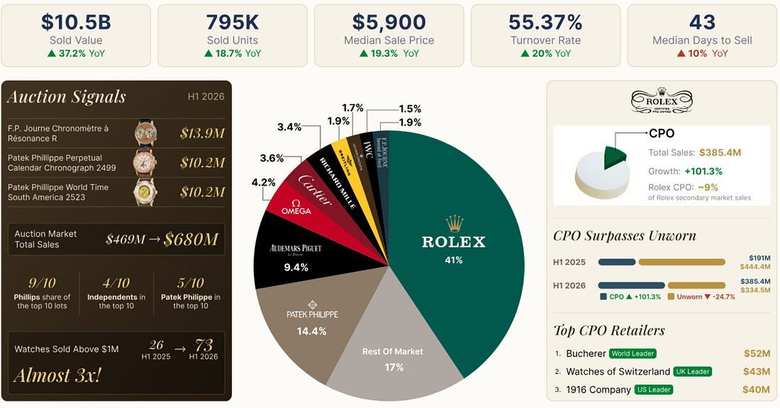
Rolex controlled 41% of the secondary watch market by value during the first half of 2026. Richard Mille recorded the highest median price among the seven largest brands, Tudor converted the greatest share of available inventory into sales among the top 30, and F.P. Journe increased sales value 196.88%.
EveryWatch based its H1 2026 Secondary Market Report on completed transactions from 650 dealers and 472 auction houses. The market generated $10.5 billion in sales, up 37.2% year over year on 795,000 watches sold. Median prices rose 19.3% to $5,900, while the turnover rate by value increased from 46% to 55.37%. Selling time moved in the other direction, with the median rising from 39 days to 43.
ROLEX WON ON VOLUME
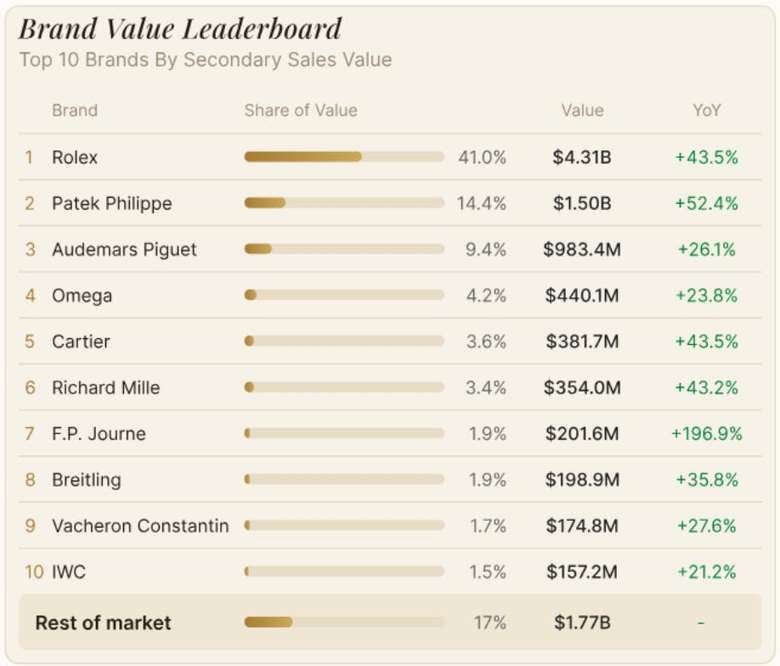
Rolex generated approximately $4.3 billion in secondary-market sales. Patek Philippe held 14.4% of the market, Audemars Piguet 9.4% and Omega 4.2%. The combined share of those three brands still fell short of Rolex.
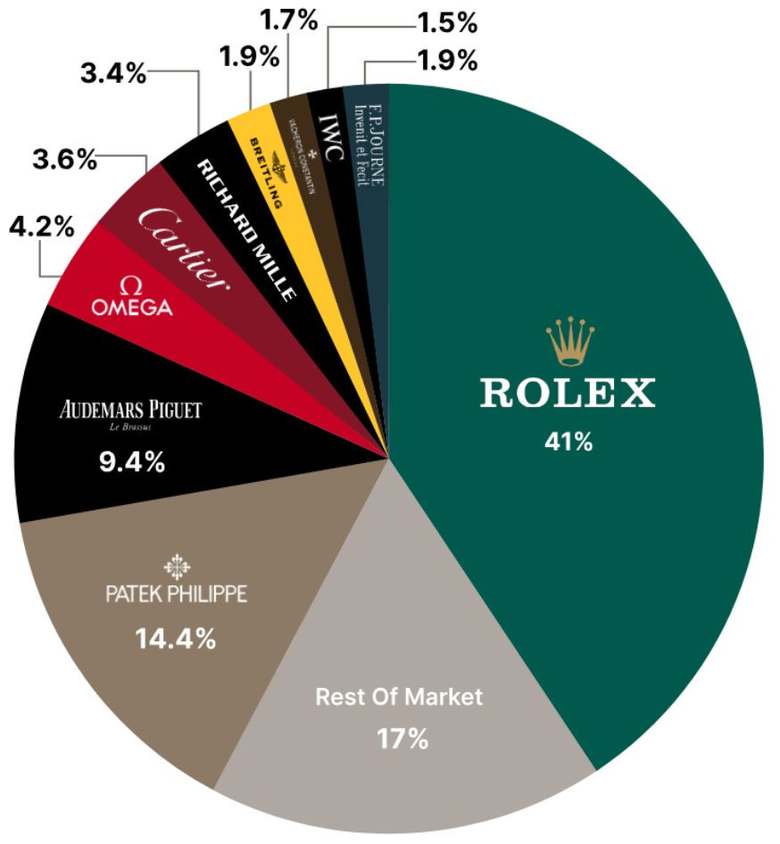
Rolex sold 227,106 watches in six months at a median price of $13,937. Its total sales value increased 43.51%, compared with 37.2% for the overall market. That transaction volume gives dealers and collectors a large pool of comparable sales, which makes Rolex inventory easier to price and usually easier to resell. A Rolex effectively comes with its own price-discovery system.
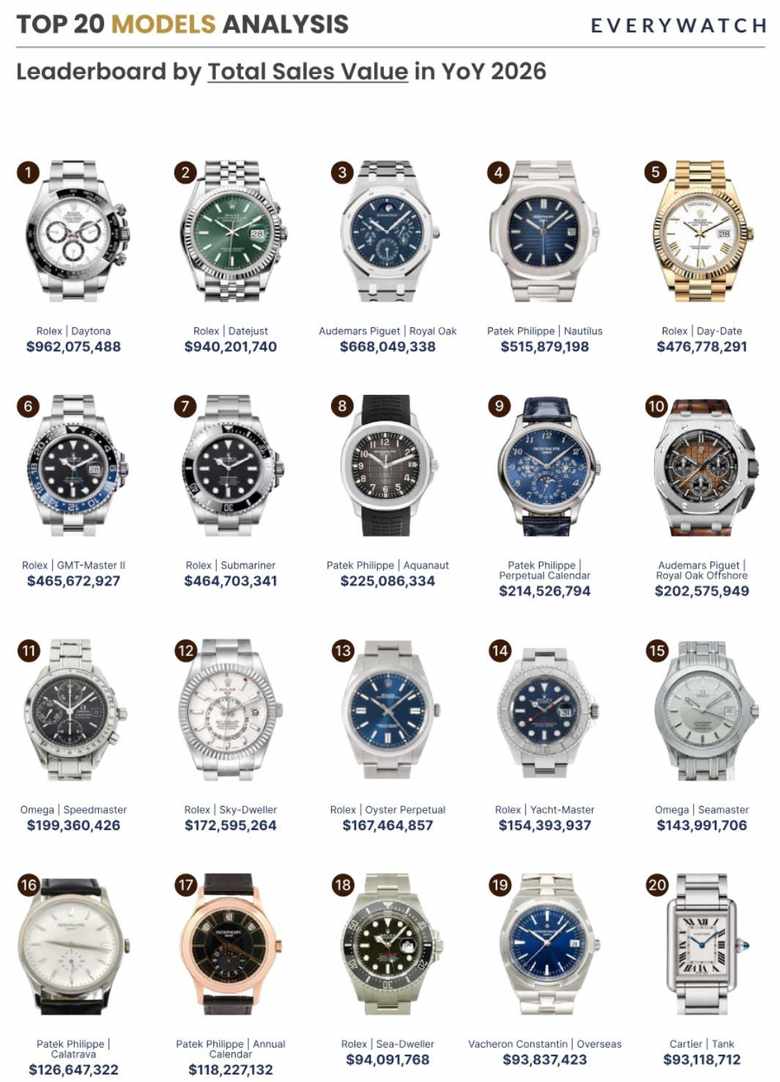
The Daytona generated $962 million and the Datejust generated $940 million, placing them ahead of the Royal Oak at $668 million and the Nautilus at $516 million. The GMT-Master II rose 60% to $466 million and narrowly passed the Submariner at $465 million, with EveryWatch linking much of that growth to demand surrounding the discontinued “Pepsi.”
ROLEX CPO TURNED CERTIFICATION INTO SALES
Rolex Certified Pre-Owned sales increased 101% to $385 million and reached 9% of all secondary Rolex sales. Unworn Rolex sales fell approximately 25% to $335 million and an 8% share. CPO moved ahead of unworn Rolex in a single year.
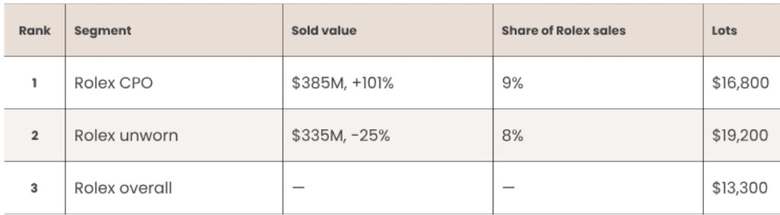
Price helped explain the shift. The average CPO Rolex sold for approximately $16,800, between the broader Rolex average of $13,300 and the $19,200 average for an unworn example. Buyers paid more for certification and dealer backing while keeping a meaningful discount to unworn inventory.
Retail performance varied widely. Bucherer led CPO sales with $52 million, followed by Watches of Switzerland at $43 million and the 1916 Company at $40 million. The 1916 Company sold a CPO Rolex in a median of 24 days, while Mappin & Webb required 150 days. That spread points to major differences in pricing and inventory management among authorized retailers.
PATEK PHILIPPE GAINED GROUND ON AUDEMARS PIGUET
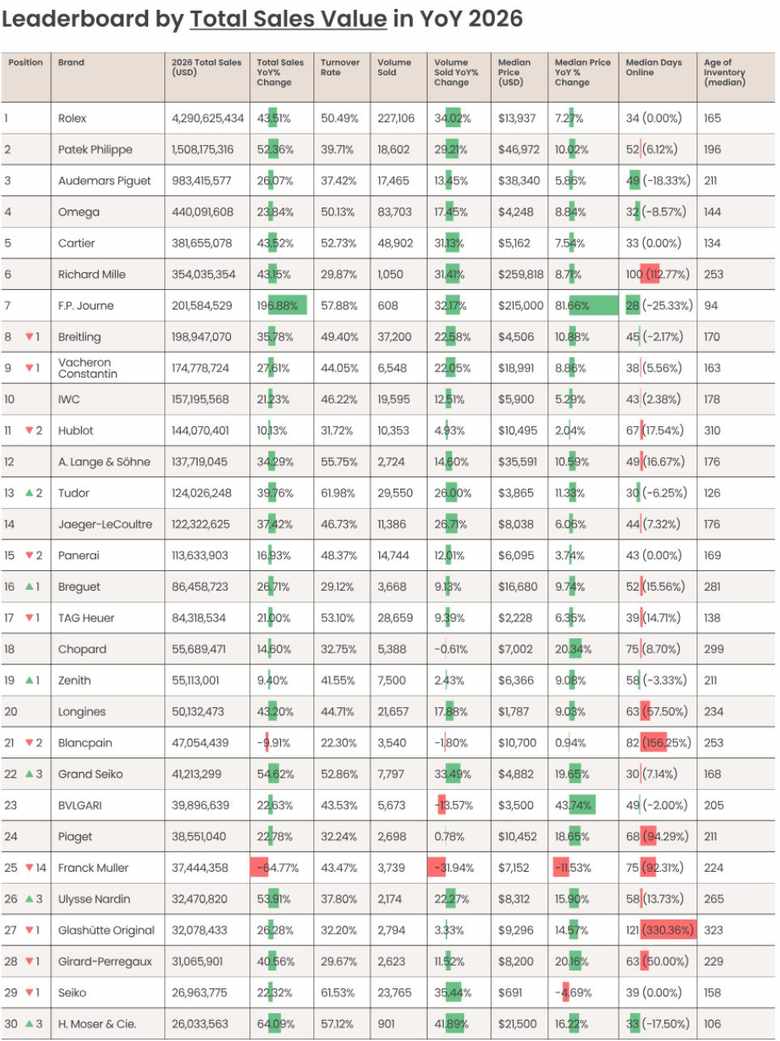
Patek Philippe’s secondary-market sales increased 52.36% to $1.51 billion, nearly twice Audemars Piguet’s 26.07% growth to $983 million. Patek’s unit sales rose 29.21%, compared with 13.45% for AP. More Patek watches changed hands, and the median price increased at the same time.
Growth also extended beyond the Nautilus, which rose 46% to $516 million. The Aquanaut climbed 65% to $225 million and passed the Royal Oak Offshore for the first time. Patek’s Perpetual Calendar collection increased 65% to $215 million, while its Chronograph collection gained seven positions on 55% growth.
VALUE RETENTION DEPENDS ON HOW IT IS MEASURED
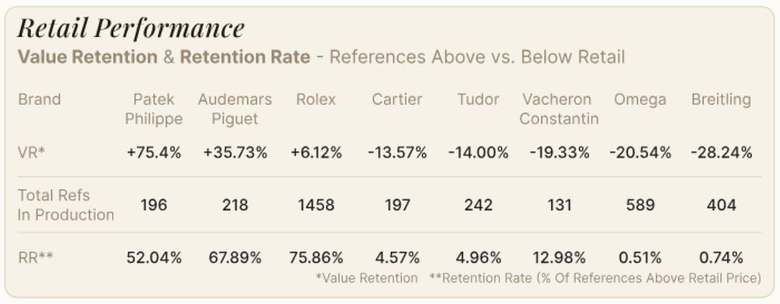
Patek Philippe recorded the highest average premium to retail among the eight major brands in the report, at 75.4%. Audemars Piguet followed at 35.73%, with Rolex at 6.12%. Those were the only three major brands that traded above retail on average.
Rolex led when EveryWatch measured the proportion of each brand’s references trading above retail. Approximately 75.86% of Rolex references cleared retail, compared with 67.89% for Audemars Piguet and 52.04% for Patek Philippe. Rolex’s average premium was relatively small, but it applied across a much broader part of the catalog.
Patek’s figures also illustrated the effect of primary-market pricing. Its average secondary premium declined from 82% to 73% after a retail price increase, then recovered to approximately 75% in June. A higher retail price narrows the measured premium even when the secondary price remains steady.
RICHARD MILLE WON ON PRICE
Richard Mille generated $354 million from only 1,050 watches at a median price of $259,818. That was the highest median among the top seven brands and almost 19 times the Rolex median. Few brands can produce that much sales value from such limited volume.
The liquidity figures were weaker. Richard Mille recorded the lowest turnover rate among the top seven at 29.87%, and its watches took a median of 100 days to sell. Cartier’s greater volume pushed it ahead in total sales, $381.7 million to $354 million, even though Cartier sold at a far lower price per watch.
Richard Mille’s inventory carried a median age of 253 days, the oldest among the seven largest brands. The figures describe substantial pricing power along with a limited pool of buyers at those prices. The second half will show whether that inventory begins to move more quickly.
F.P. JOURNE COMBINED PRICE GROWTH WITH FASTER SALES
F.P. Journe generated $201.58 million from only 608 watches. Sales value rose 196.88%, while the median price increased 81.66% to $215,000. No other brand among the top seven approached that growth rate.
Several large auction sales lifted the headline figure. Journe placed four watches among the half’s ten largest auction results, led by a Chronomètre à Résonance at $13.922 million. Those four watches generated approximately $28.8 million, or 14.3% of the brand’s total secondary-market sales.
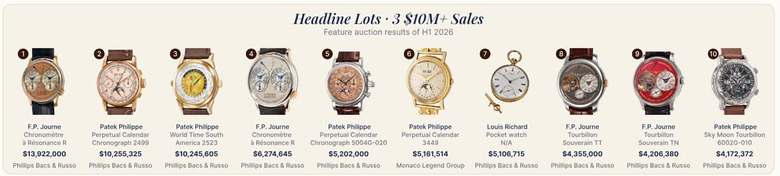
Removing those four transactions reduces F.P. Journe’s year-over-year growth from 196.88% to approximately 155%. The adjustment is conservative because it removes the exceptional 2026 results without making a corresponding change to the prior-year total. Growth still remained far ahead of every other top-seven brand.
The rest of the data also points to demand beyond the major auction lots. Unit volume rose 32.17%, turnover reached 57.88%, and median selling time fell 25.33% to 28 days. F.P. Journe approached Richard Mille’s median price while selling more than three times as quickly and converting almost twice the proportion of available value into completed sales.
Read Is F.P. Journe a Bubble? The Data Behind Its 197% YoY Surge
THE REST OF THE TOP 10
Breitling ranked eighth with approximately $199 million in sales, up 35.78%. Vacheron Constantin ranked ninth at $174.8 million on 27.61% growth, while IWC completed the top 10 at $157.2 million, up 21.23%. All three grew, although each remained below a 2% share of the market.
Omega stood apart from that group in fourth place. It generated $440 million and held a 4.2% market share, the final position above 4% before the rankings narrowed sharply. Cartier and Richard Mille followed in the mid 3% range, with every lower-ranked brand below 2%.
TUDOR WON ON TURNOVER
Tudor climbed two positions to thirteenth as sales value increased 39.76% to $124 million. Its turnover rate reached 61.98%, the highest among the top 30 brands and slightly ahead of Seiko at 61.53%. Tudor watches sold in a median of 30 days at a median price of $3,865.
The Black Bay recorded a 95% turnover rate, the strongest of any collection in the report. Tudor also traded approximately 14% below retail on average, and fewer than 5% of its references sold above retail. Its strong turnover reflects accessible secondary pricing and steady demand, while its value-retention figures remain modest.
INDEPENDENT WATCHMAKERS GREW UNEVENLY
Independent brands generated approximately $354.6 million, up 89.03% year over year. That total exceeded the $284.1 million in secondary sales attributed to LVMH’s watch portfolio. Richemont and Swatch Group remained larger at $617 million and $633.8 million, respectively.
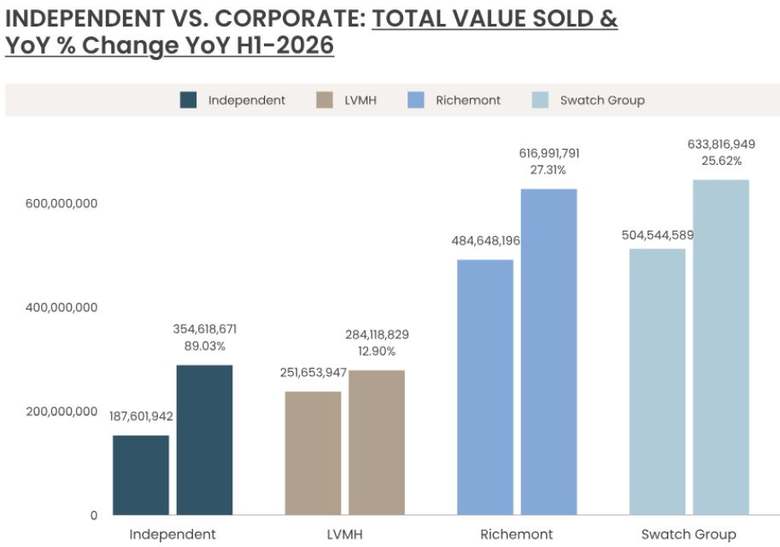
F.P. Journe accounted for more than half of the independent total. H. Moser & Cie. grew 64% to $26 million, Parmigiani Fleurier rose 60% to $21 million, and Daniel Roth increased 104% to approximately $6 million. M.A.D. Editions climbed 33 positions as sales value rose 228% to $4.8 million.
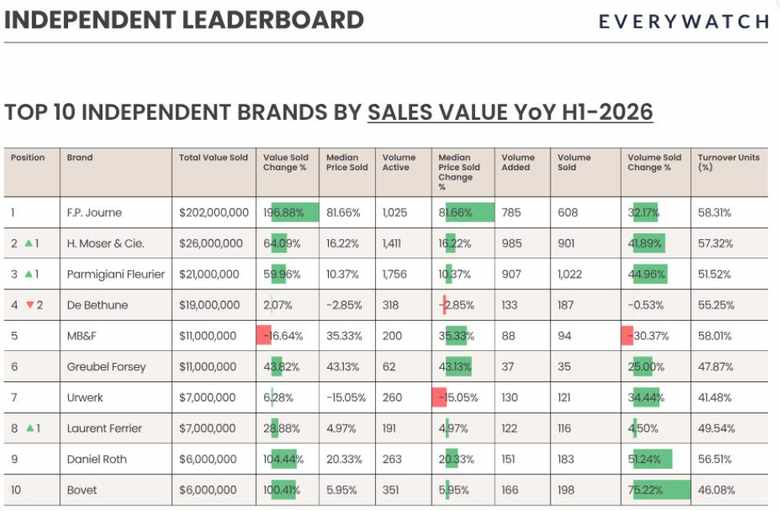
Results elsewhere in the category were much weaker. De Bethune grew only 2%, MB&F declined 16.64%, and Franck Muller fell 14 positions as sales value dropped 64.77%. Buyers concentrated their spending among a relatively small number of independent watchmakers.
Read The GRØNE Horologium: Gone in Six Minutes
WHAT WE WANT TO SEE IN THE SECOND HALF
F.P. Journe’s 57.88% turnover rate will be one of the clearest tests of whether its growth can continue. More supply could lengthen selling times or reduce the rate at which listings convert to sales. Stable turnover at a $215,000 median would support the view that demand extends well beyond the major auction pieces.
Richard Mille faces a different issue. Its $259,818 median remains the highest in the group, but a 100-day selling cycle and 29.87% turnover rate leave considerable room for improvement. Cartier could widen its lead in aggregate sales if Richard Mille inventory continues to move slowly.
Tudor’s turnover will also be useful to follow as prices rise. The brand currently combines a $3,865 median with a 14% average discount to retail, and that pricing supports liquidity. A higher median could test how much of the current demand depends on that discount.
Rolex CPO will show whether certification continues to take share from unworn inventory. Retailers with long selling times may need to adjust prices or change the mix of watches they hold. Another period of rapid CPO growth would confirm that buyers increasingly assign value to authentication and dealer support.
Vacheron Constantin enters the second half with a reasonable lead over IWC, $174.8 million to $157.2 million. Both brands grew more slowly than several names around them, so a relatively small change in momentum could alter the lower end of the top 10. Their sales and selling times should provide a useful reading on demand outside the dominant brands.
The market-wide median selling time may be the most useful figure to track. It rose from 39 days to 43 even as sales value, volume and turnover improved. If selling time stabilizes while turnover remains near 55%, buyers are continuing to absorb more expensive inventory. A further increase would suggest that sellers are raising prices faster than demand can follow.
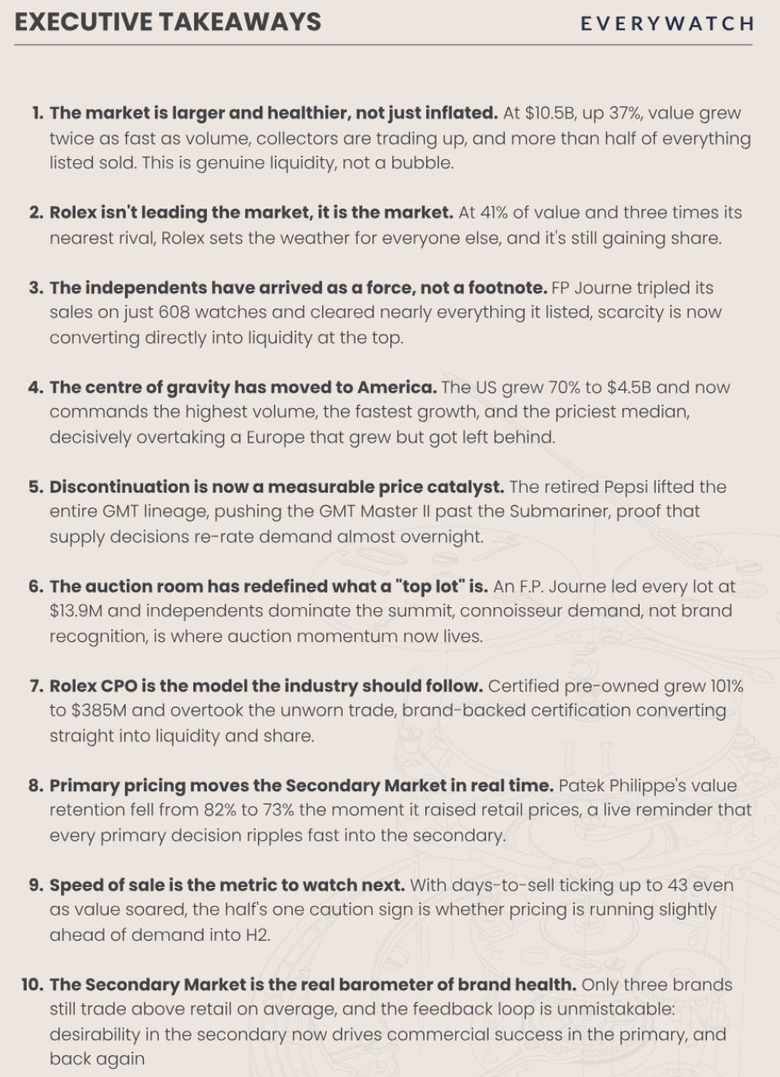
Source: EveryWatch H1 2026 Secondary Market Report.
Next up: Audemars Piguet Finally Sells Used Watches: 8 Years, 2 CEOs and a 20% Fee
ABOUT
Watch Lover XO is written by two collectors who wear and follow watches, from everyday favorites to rare independent pieces. We cover the secondary market, new releases and the watchmakers behind them.
For more images and videos, follow watchlover.xo on Instagram.